How we write these
Every page on this site follows the same rules. Here they are.
The guides, the worked examples and the checklists are written for people in a dispute who are not lawyers. They say what to write down and keep. They never say who is right.
The short version
Four things you can rely on.
- 01
Both sides, every time.
Half of every dispute is someone answering it. Every situation we write up covers the person raising it and the person it’s raised against.
- 02
No law, no deadlines, no advice.
We say what to record and keep. We don’t name laws, quote time limits or tell you what you’re owed. Rules differ by state; a lawyer can tell you yours.
- 03
Made-up people, and we say so.
Every worked example is invented, names and amounts included, and labeled as an example twice on the page. Nobody’s real dispute is ever used.
- 04
Dated, and checked again.
Each worked example, and this page, shows when it was published and when it was last reviewed against the product as it is today.
What we write
Four kinds of page, one job: what to write down.
The rules
What every page is checked against before it goes live.
Several of these are checked automatically: a page that breaks one doesn’t publish.
- R1
No outcome words. Never “proof”, “court-ready”, “win” or “guaranteed”. A record shows what was written down and when; it doesn’t decide anything.
- R2
No law names, no time limits. We may say where something is reported. We never say what the law requires.
- R3
Never pick a villain. Landlords, contractors and businesses get accused too. Examples alternate which side they’re written from.
- R4
Ordinary on purpose. An ordinary amount, an ordinary silence. The dramatic case lets the reader off the hook because it isn’t them.
- R5
The gaps matter more than the wins. Every worked example lists what was missing from the record, honestly.
- R6
The product, as it is today. Anything we say BuildMyEvidence does, it does now. Every “will” and “won’t” is re-read when the product changes.
- R7
No figure without a named source. If a number can’t be traced, it isn’t on the page.
Anatomy of a worked example
Six parts, in the same order, on every case.
So you always know where to look, and so a case can be compared with the next one.
- 1The question it answersThe real search question, in plain words.
- 2The case in one lineReadable on its own, with no context.
- 3Which way roundRaising it, or answering it.
- 4The recordTheir side and yours, numbered and dated, silences shown.
- 5What carried it, what was missingThree entries that did the work. The gaps, numbered.
- 6What to take from itA few lines that apply to your own record, either side.
A bathroom that stopped halfway
The change everyone was relying on was never in the written quote — it was agreed in a group chat about tile colors, and it survived only because one person screenshotted that week’s messages for an entirely different reason.
Feb 24
Feb 25
Mar 2
Inside the app
The same rules hold inside the product.
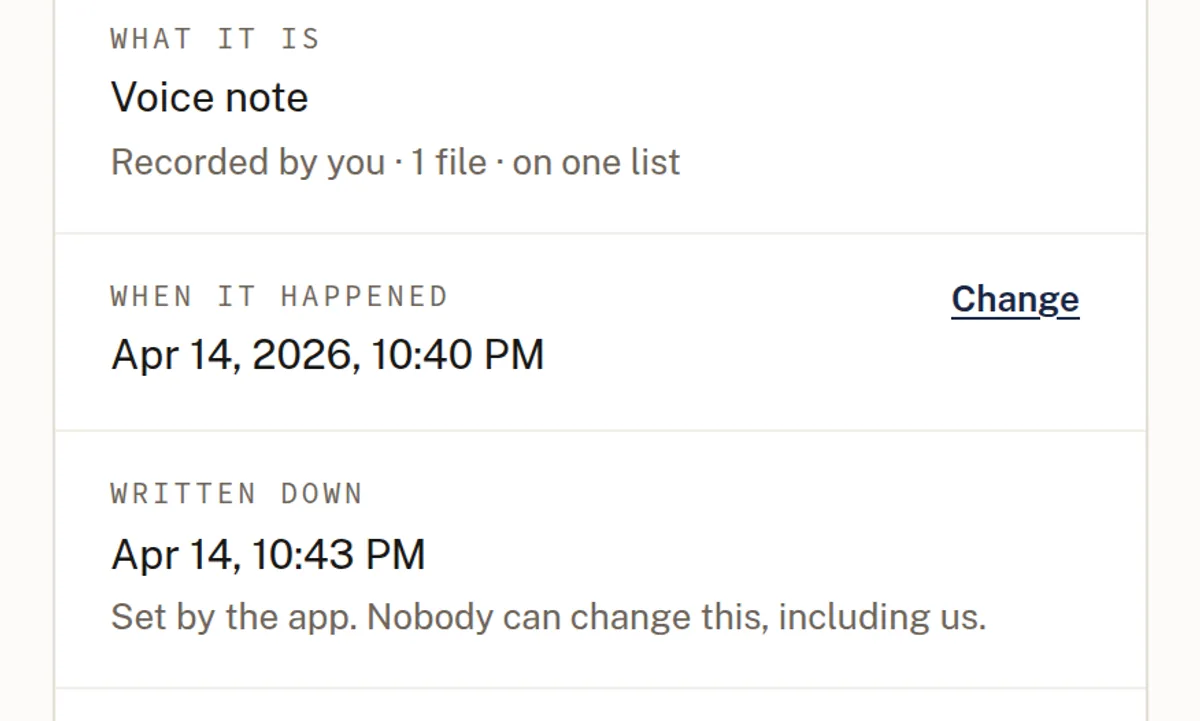
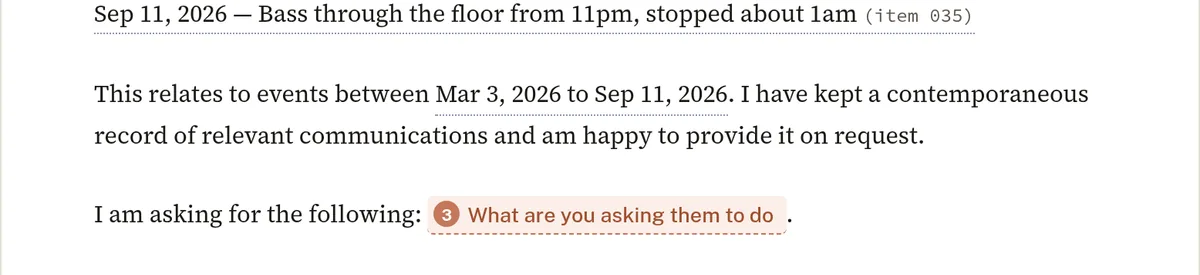
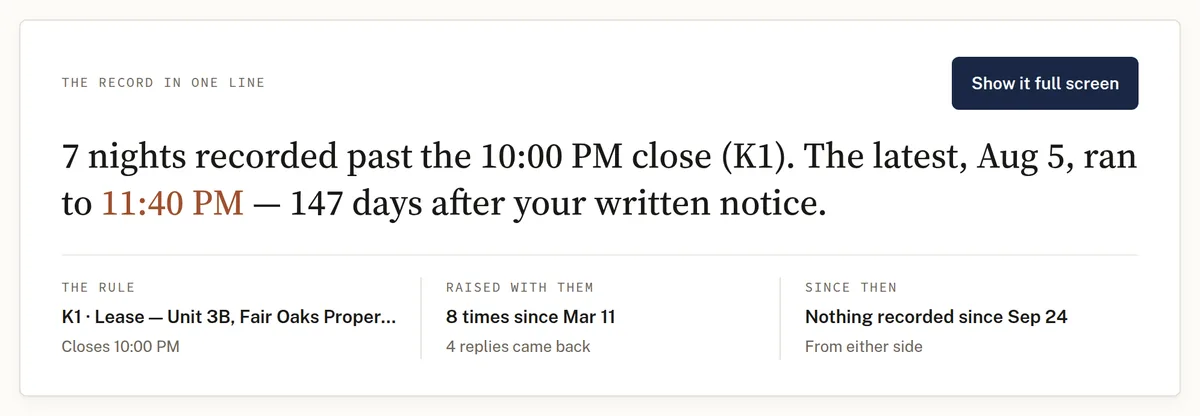
These pictures come from a sample case, never a real person’s, and are retaken whenever the app changes.
Reviewed
What “last reviewed” means.
The page was read again against the rules above and against the product as it is that day. Anything that had stopped being true was changed.
Recent changes
- Every page now tells search engines its own correct address.
- Every situation page rewritten to cover both sides. Eight guides added for people answering a claim.
- Inactive-account rule rewritten in plain words on every page that states it.
- This page first published.
Found something wrong?
Tell us which page and what it says. If it’s wrong, we fix it and it goes in the change log above.
Start the record today.
Start your case free. Pay only when you want the finished case file.
New to keeping records? Read how to use BuildMyEvidence →